I love my alpacas. Not only are they gentle, passive, interesting, majestic creatures each with their own personality, but they provide beautiful, luxurious fleeces that allow me to engage in many creative endeavors using their fiber, which then helps to feed my family, but best of all feeds my soul ...

Okay, that was deep! Alpacas also produce manure, and it is great stuff ... I have used it as fertilizer many places on our farm, some of which I wish I hadn't, as I now have enormous bushes around my house that have grown so fast they'll probably have to be dug out sometime soon.
I also have beautiful flowers, thanks to my alpacas. And I learned a little about daylilies today...

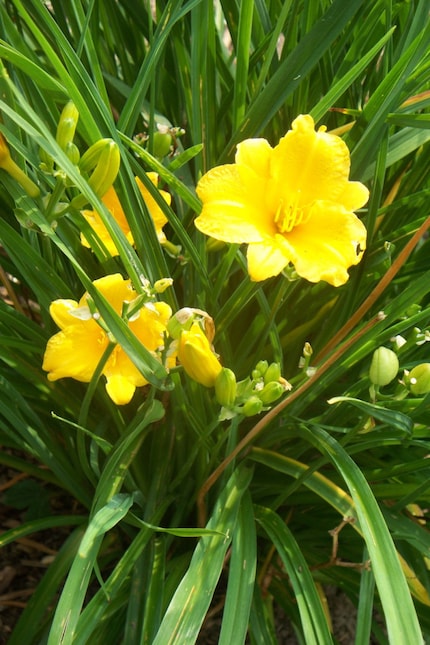
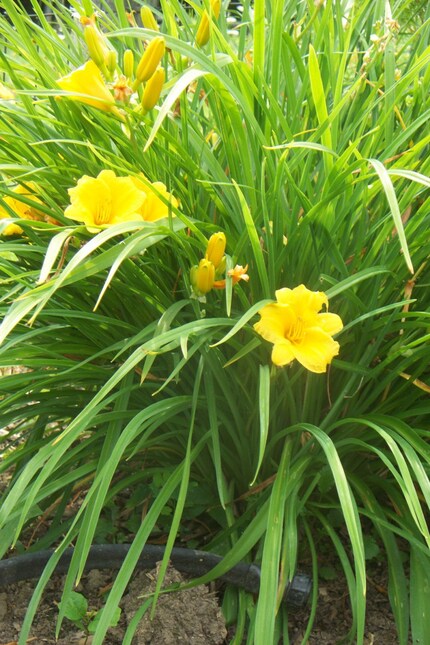
This is the now-famous daylily that started the race to the "rebloomers." The name Stella d'Oro translates to "Star of Gold".
Today, it's a national trend, and "Stella" is the number one daylily in the country. Many gardeners say their "Stellas" are in bloom practically all summer and fall. And this is why this variety is planted almost everywhere now--you'll see them in median strips on interstates and in almost all good commercial landscaping, even at gas stations and fast food restaurants.
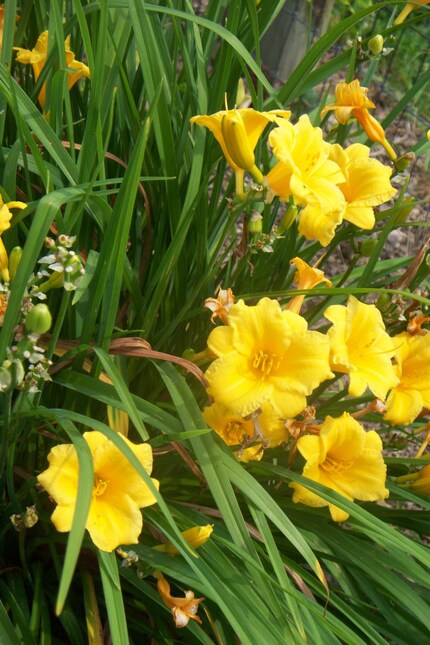
This all tells you that this is a no-maintenance, and I am into no-maintenance, easy-bloom perennial--what better reason to add it to your garden!

It all started with the original "wild" orange daylily. Many Americans think the tough old orange daylily they see in old gardens and along roadsides is a wildflower, but it really isn't. No daylily is native to North America; most hail from Asia.

Daylilies are not really "lilies." In fact, they are quite different. True lilies grow on tall stems with flowers at the top.
 Daylily flower stems (called "scapes") are generally much shorter, and grow from a fountain of grass-like foliage at ground level.
Daylilies don't grow from bulbs like true lilies. Daylilies form a mass of thickened, fleshy roots. These unique root systems hold so much moisture and nutrients, the plants can survive out of the ground for weeks. This survival system, making them tough, and really easy to handle, is one of the reasons they're so popular today. They're also dependably hardy, so once you have them, you have them for years.
Daylilies don't grow from bulbs like true lilies. Daylilies form a mass of thickened, fleshy roots. These unique root systems hold so much moisture and nutrients, the plants can survive out of the ground for weeks. This survival system, making them tough, and really easy to handle, is one of the reasons they're so popular today. They're also dependably hardy, so once you have them, you have them for years.


Today's craze for reblooming daylilies all began with Stella d'Oro, the now-famous yellow dwarf daylily that blooms once during late spring and then again in late August and into fall.